Just published

In joyful strines: The ultimate record of Australian vocabulary

Pinned to the wall of one of the offices of the Australian National Dictionary Centre in Canberra is a cartoon of a monk being interrupted as he patiently illuminates the Book of Kells.

The caption: “Deadline? Nobody told me anything about a deadline.”

Such was the journey of the Australian National Dictionary, a tome that last emerged from its hermit’s grotto in 1988, to reappear 28 years later in even greater splendour.

Late last year the manuscript was piled on a desk and illuminated in red ink:

Australian National Dictionary manuscript

And here it is now, all bound and jacketed:

Advance copy

The continuity on this project is truly remarkable with a number of the same lexicographers contributing to both the 1988 and 2016 editions.

Oz lexicography's larrikin rat-pack: Mark Gwynn, Amanda Laugesen, Bruce Moore, Julia Robinson.

Australian lexicography’s rat-pack: Mark Gwynn, Amanda Laugesen, Bruce Moore, Julia Robinson.

I would like to think that since 1988, attitudes to Australian English have matured. In linguistic research, more and more regional diversity is being detected, and despite the occasional self-hating wacko most speakers recognise the richness, expressiveness and sheer oddness of our lexicon.

When I read British or American stories to my children I often flip the text into Oz English. I’m not being a nationalist, I just enjoy owning the words.

I worked on the new edition of the AND for a mere six months in 2011, plodding through Aboriginal words in Australian English beginning with ‘M’; marn grook and Moomba are particularly memorable.

As an historical dictionary the AND is not only a record of the words we now choose but an account of how we once spoke. Many of the terms I investigated were utterly unfamiliar to me and may have entered into speech for a decade or less. These words are lexical polaroids of a society in transition, and a reminder that even if relatively new and popular terms like budgie smugglers eventually pass into obscurity, they will still be remembered by the AND. 

Standard
Writing systems

One ring to fool them all?


Sven Van Haelst of Maaseik in Belgium is an archeologist by training who recently discovered this copper/bronze ring in his backyard. He would like help identifying the script used in the inscription.
Sven_Ring inscription
From haphazard corridor discussions at the MPI we have arrived at the following:
  • It may be a kind of decorative script since there seems to be quite a lot of repetition, but if the signs are purely decorative, why are they on the inside of the ring?
  • 3, 5 and 7 are possibly the same character, and this might be modified with a diacritic in 9
  • 4 might be a diacritic modification of 1, by the same mechanism
  • If it’s not decorative and is representing language, there are higher odds that it is an alphabet or alphasyllabary, given the rate of repetition (albeit in a tiny sample) as opposed to a syllabary
  • Not sure 1 is a character at all, people often use this sign as decorations/fillers inside rings.
  • This might be some alphabetic rendition of a name, or perhaps a private cipher (possibly recent)
If anyone has any ideas about this please let me know and I will update this post with new theories or information.
This blog is rarely updated! Want an email notification whenever there is a new post? Click on the follow button right at the top ↑ that looks like this: Screen Shot 2015-10-18 at 10.02.26 am
Standard
Uncategorized

Hier

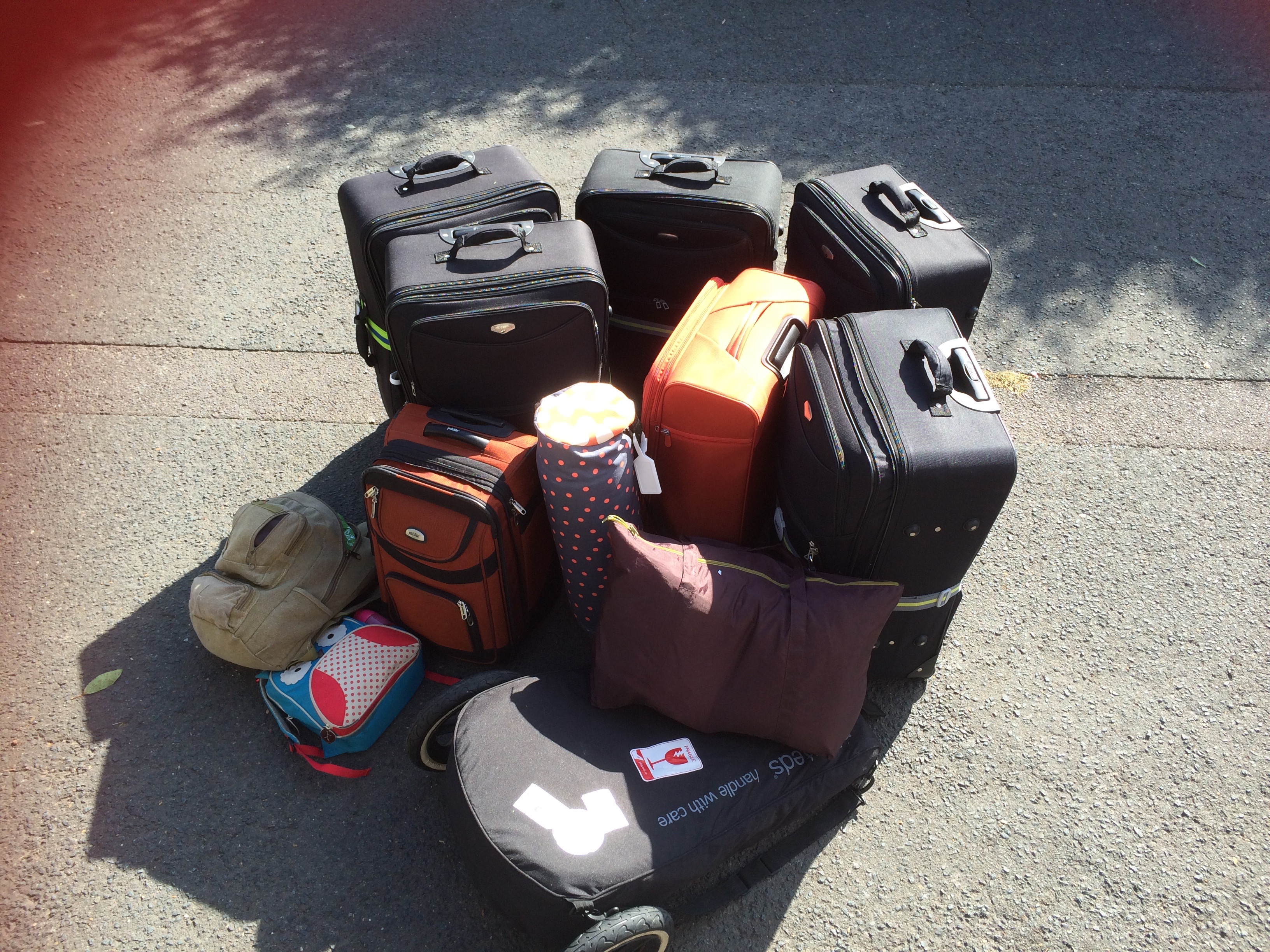
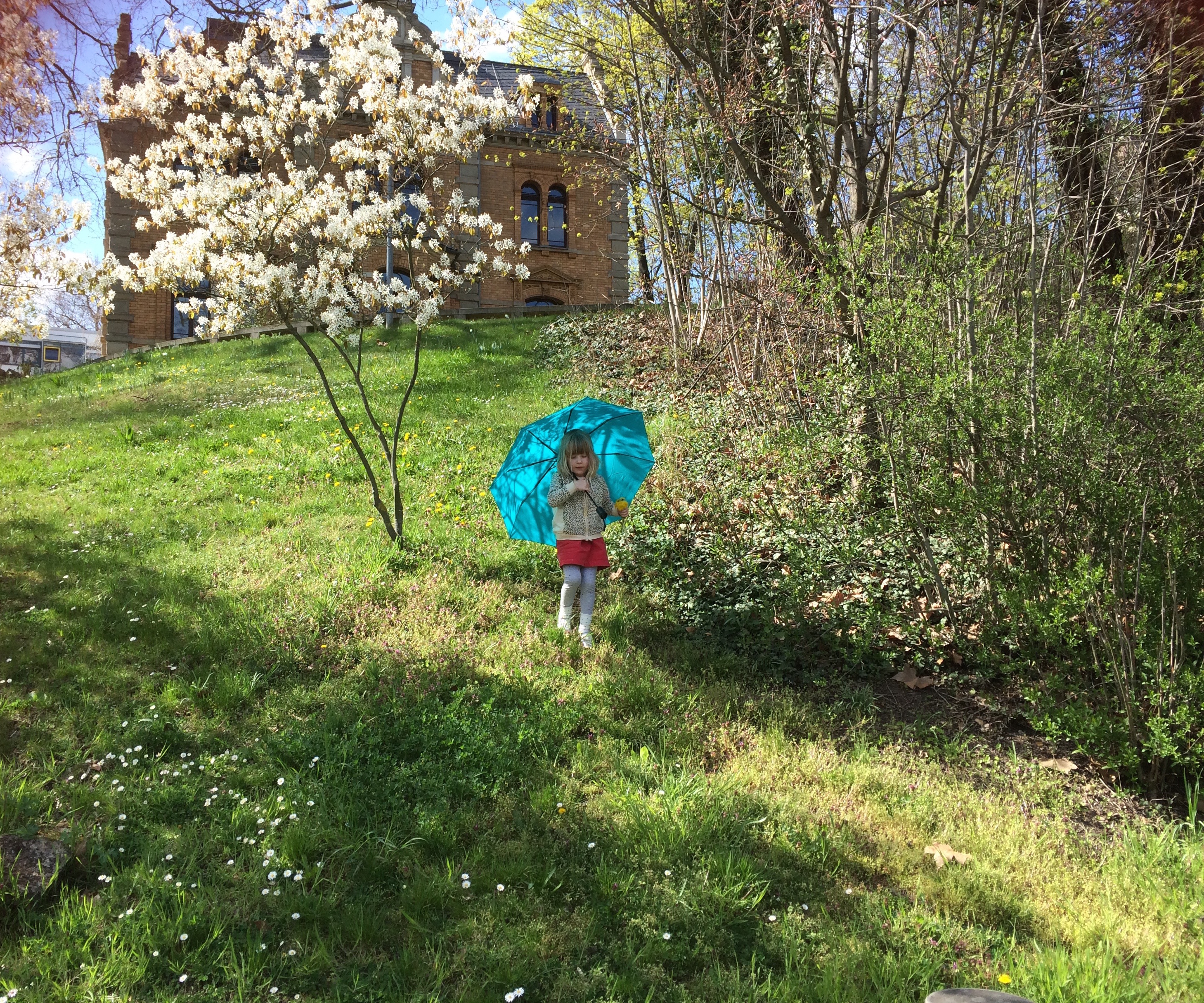
Seven pieces of luggage, three planes, two trains, two days, two kids. We’re in Jena. Spring has also arrived and everything is blossoms and light – a far cry from my last visit in November when the town felt dark and empty of people.

IMG_1962

We’ve had one exciting day when it snowed just a bit. I never realised that snow does not fall silently as the poets claim. You can hear it faintly crackling through the branches of trees before it hits the ground.

IMG_2008

Our flat in Damensviertel is perfect and our neighbours are really the best. In amongst all the paperwork I have started pecking around the edges of the research project. I’ll keep you up to date.


Standard
Just published

A peacock’s tail of a script: Why Eskaya is the least probable writing system in the world

After years of being tangled up in the esoteric Eskaya script from the southern Philippine island of Bohol, I have an article in the latest issue of The Australian Journal of Linguistics that summarises everything that I’ve learned about it. This is certainly not everything that there is to know on the subject and it’s been a case of ‘the more you look, the more you see’. I’ve decided it’s high time for me to look away before I either damage my eyesight or come up with another analysis.

You can view and download it here, and if your institution doesn’t give you access please grab the pre-publication version here.

!peacock_graphic

(The article contains examples of the early ‘demonstration set’ of the Eskaya font created in consultation with Marsiana Galambao, advice from Siva Kalyan, and the vector graphic skills of designers in Bohol, Luzon and Australia.)

To consider only at its outward graphic form, the Eskaya script appears ostentatiously calligraphic with a profusion of loops and curls that seem to mimic cursive handwriting in the Roman script. But the complex system underlying the script is just as excessive, with multiple mechanisms for representing linguistic sound. This abundance goes against the grain of how we might assume ordinary writing systems to evolve: towards greater simplicity and consistency.

Eskaya is no ordinary writing system. It belongs to a little-known tradition of new indigenous systems that have emerged independently of major script families – even if they may be influenced by them in the graphic shape of some of the letters. Cherokee and Vai are two such scripts from the nineteenth century, but a more fertile period of independent script creation was the first half of the twentieth century when talented individuals created dozens of new varieties of writing across West Africa,  the Asia-Pacific and the Indian subcontinent. These emergent scripts were frequently associated with local demands for self-determination, ethnic revitalisation and a revised moral order, sometimes in the aftermath of violent struggle.

Photograph by Cherry Policarpio 1991. In the foreground is Raymonda Acerda, the child on the left is Jessame Maquiling.

Photograph by Cherry Policarpio 1991. In the foreground is Raymonda Acerda, the child on the left is Jessame Maquiling.

Eskaya writing has intrigued Philippine tabloid journalists and local enthusiasts ever since it became known to the wider world in the early 1980s. Mystics and lay historians have suggested an origin in any number of the following scripts and script families: Greek, Indic, Egyptian, Phoenician, Arabic and Javanese. But surprisingly, the most common theory is that both the script and its associated language are derivations of Hebrew, a notion that goes hand in hand with an increasingly popular view on the island that the people who use the script are descended from a Lost Tribe of Israel.

By contrast the roughly 550 people who write in this script today contend that Eskaya was created by the heroic ancestor Pinay and later ‘revealed’ in the 1920s to the veteran rebel Mariano Datahan (ca. 1875–1949) whose Messianic agenda had by that time attracted a large following in the southeast of the island. Having endured brutal conflict and successive occupations, Datahan’s followers valued the script as an index of an uncorrupted pre-contact civilisation free from foreign influence.

Pinay inmunsiktur

Pinay inmunsiktur (‘Pinay the Pope’)

Pinay was more productive than most other script inventors since this ancestor was also responsible for creating an entirely new language—referred to as Eskayan or Bisayan Declarado—to go along with the script. As far as I know, the Medefaidrin language-script of Nigeria is the only other case of dual creativity of this type.

The identity of Pinay—described as the first ‘Pope’ in the Philippines—is comfortably plural. It is not so much contested by Eskaya people as variously expressed. For some, Pinay was a man, for others a woman. In certain stories Pinay lived prior to Spanish colonisation while others place him or her in the contemporary period. The late chieftain of the Eskaya village of Taytay believed that Pinay and Mariano Datahan were the same individual, and this particular conceptualisation is most consistent with what I have been able to learn from my analysis of the script.

Eskaya displays a plausible influence from the pre-contact alphasyllabic Philippine script in its use of inherent vowels and also in the emic metalanguage that scribes use to identify graphic elements of letters and their vocal realisations. There is, however, a much more obvious influence from the Roman alphabet, and from Hispanic orthographic rules. The borrowing of the ‘k’ form (for /-k/) among other pieces of evidence suggests an early twentieth-century origin (see the article itself for my explanation).

What is so fascinating about Eskaya is that it violates every common sense maxim of how a writing system ought to work. While Eskaya is used for writing the Eskayan language, as well as Visayan and occasionally English, there is absolutely no ‘underlying rational of efficiency‘ when it comes to expressing the phonology or morphology of any of these languages. In fact, extravagant superfluity of both form and system is the order of the day.

Eskaya is primarily a syllabary since its characters tend to express discrete syllables, but it nonetheless combines a wide array of systems: (cypher)-alphabetic, alphasyllabic, syllabic and ideographic. One aspect of the system that is particularly challenging from the perspective of a learner is the use of what I term ‘pseudo-diacritics’. These are one-off graphic elements for representing syllable codas but they have no independent or consistent sound value outside of the specific syllable they are attached to. In other words, a graphic element representing a glottal coda in one syllabic letter may represent a semi-vowel coda in another and an engma in a third. And although the hand-written reference syllabaries used by contemporary scribes include up to 1065 characters, only about 460 are actually used today. At least 37 recorded Eskaya letters represent sounds that are not phonotactically possible for the language.

A peacock's breakfast. Words in red are emic terms.

A peacock’s breakfast. Words in red are emic terms.

On this basis I made the bold claim that Eskaya is “the least systematic writing system on record and in regular use today”. (Well, it passed peer review, so it must be true!)

I also argued that the lack of systematicity is a feature and not a bug, and that there is evidence that Pinay introduced a degree of deliberate opacity and misdirection. I suggested that its ‘inefficiency’, ‘superfluity’ and the huge personal commitment required for its acquisition make it both impenetrable to outsiders and appealing to its scribes and scribes-in-training.

Much like Darwin’s famous example of the peacock’s tail, the Eskaya writing system is cumbersome and impractical but also attractive in its intricate excess—and it is perhaps this inelegant beauty that has ensured its survival as new generations continue to acquire the system nearly a century since it was first revealed.

This blog is rarely updated! Want an email notification whenever there is a new post? Click on the follow button right at the top ↑ that looks like this: Screen Shot 2015-10-18 at 10.02.26 am


Standard
Uncategorized

“Philologia Rediviva?”

Tony Woodbury at the University of Texas passed me this recent article by Sheldon Pollock on the meaning and prospects for philology in the 21st century. And there’s a nice shout-out to Zukunftsphilologie.

In short, we may well be standing on the verge of a historic event: the inauguration of a world without philology for the first time in three thousand years. […]

… philologists must develop a new disciplinary formation, with a new intellectual core. For as defined here, philology, unlike philosophy and mathematics, has never had a disciplinary home in which its real capacities could develop. If it did achieve some measure of institutional dominance in the nineteenth-century European university, this was because of the veneration then paid to the study of the classics. […]

Beyond the academy, philology – though one that does not know its name – continues to broadly influence the public domain. It is ironic to observe, given the decline I have charted, how significant are the philological energies across the Internet on sites like “Rap Genius” (http://rap.genius.com), a self-described “crowd-sourced (and artist/producer-sourced) annotation of rap lyrics/beats, from ‘Rapper’s Delight’ to ‘To Pimp A Butterfly.’” Users, including original creators, provide annotation to the often complex lyrics of songs, as well as intertextual linkages and contextual material. The purpose of Rap Genius, originally named Rap Exegesis, is precisely to make sense of texts. It has recently been branching out to include other musical forms, as well as law, history, and more; it is, in fact, now simply named “Genius.” The site seeks to “annotate the world,” “to help us all realize the richness and depth in every line of text.” This is pure philology in terms of practice, albeit practice that as yet has little awareness of its history, theory, or method. Providing that context, and formalizing the discipline, is the role of the university; and today’s academy must also recognize and channel the energies of these popular philological enterprises. […]

Our goal is not only to enable students to gain a historical and theoretical grasp of textual understanding – to understand why Supreme Court Justice Scalia is wrong to assert, about the text called the U.S. Constitution, that “words mean what they mean,” and “their meaning doesn’t change” – but also to see the remarkable continuities in global philology, and, equally important, the differences, sometimes startling differences, in what it has meant for people to make sense of texts. We also want to show them how philology can be more than an academic discipline; indeed, it can be a way of living. You are how you read, and learning to read better – with greater precision, self-awareness, and, above all, respect for the diversity of textual truth in a world ever more unified and ever more in need of unity – means, potentially, learning to be better. […]

This blog is rarely updated! Want an email notification whenever there is a new post? Click on the button up top that looks like this: Screen Shot 2015-10-18 at 10.02.26 am

Standard
What I'm reading

Best journalism of 2015

Welcome to the 2015 edition of the Summer Syllabus™. For those who came in late, this is my wrap up of the most interesting things I read online over the past twelve months. This year’s list is really long, for some reason. Next year I promise to be more selective. Looking back I can pick out a few themes that have caught my attention this year but which I wouldn’t necessarily have predicted: cultural appropriation, nerd hubris (still! see last year), capitalism and public anthropology. I’ve also been fascinated by the various college-based social justice movements that are emerging on some US campuses that I suspect nobody really understands regardless of where they sit on the political spectrum or how much insider conviction they bring to their arguments.

My reading recommendations are not an endorsement of the opinions contained within – if a piece of writing makes me think about an issue in a different way then I may included it even if it also makes my blood boil. And if you read nothing else on this list, I recommend you have a look at: God Tier: Facebook moms run the meme game, The Chinese Lingerie Venders of Egypt, and The 40-Year-Old Reversion.

Architecture and aesthetics

Authors and fiction

Biography

Children and parenthood

Cultural appropriation

The curious thing that is happening on US campuses

Effective altruism

Ethics and the examined life

Ethnography

Feminism

Funny

History

Journalism

Language

Nerd hubris

Politics

Relationships

Research and higher education

Science

Technology

Terrorism

 This blog is rarely updated! Want an email notification whenever there is a new post? Click on the button up top that looks like this: Screen Shot 2015-10-18 at 10.02.26 am
Standard
Uncategorized

Moving to Germany!

jenoptik1

Image of the young Hegel in 1806 observing Napoleon through a pair of locally manufactured Carl Zeiss binoculars

Starting in April 2016 I’m taking up a two-year research fellowship at the new Max Planck Institute in Jena. I will be working within the Minds and Traditions group under Olivier Morin, looking at the evolution of writing and graphic codes. This is a question that hasn’t been addressed in any serious or sustained way for a long time and I really can’t wait to be involved.

Fittingly, the Max-Planck-Institut für Menschheitsgeschichte or the Max Planck Institute for Human History was established in the very same town in which the end of history was declared by Hegel when he was a professor at the University of Jena.

(And it’s also where Hegel famously spied Napoleon riding through town and declared “It is indeed a wonderful feeling to see such an individual who, here concentrated in a single point, sitting on a horse, reaches out over the world and dominates it” —a remark that has been much anthologised and mythologised, most recently in one of Slavoj Žižek’s letters to Nadia Tolokonnikova during her recent imprisonment.)

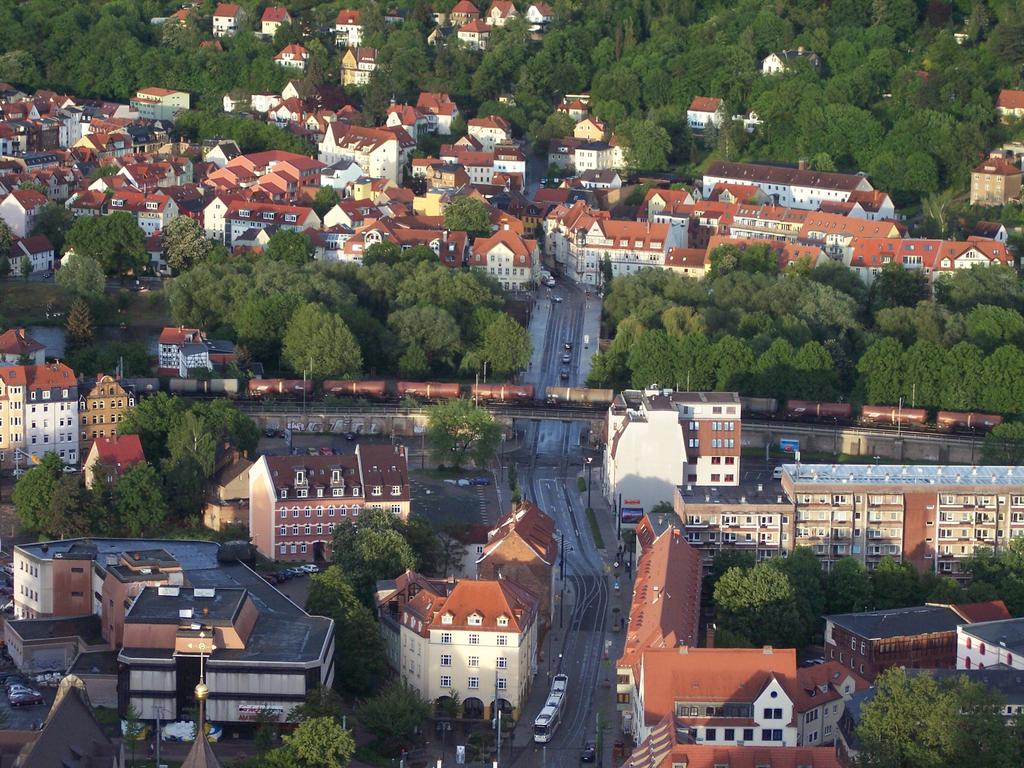
Beyond Hegel, Jena is famous for aggressive cyclists, relatively expensive accommodation, and for manufacturing high-end binoculars and camera lenses. And if you type “Why is Jena … ” into Google, it auto-completes to “Why is Jena called student paradise?” We will report our findings! It’s certainly a charming town in a very charming part of the world, and its strangely quiet despite its population of 400,000.

Jena_Town

Looking forward to doing full time research again, learning German, going on weekend family jaunts to France and the Czech Republic, and of catching up with my lovely friends and colleagues in Halle, Cologne, Potsdam and Berlin.

This blog is rarely updated! Want an email notification whenever there is a new post? Click on the button up top that looks like this: Screen Shot 2015-10-18 at 10.02.26 am


Standard
Conferencing

10 things I learned at World Scripts in Cape Town

It’s been some time now since the World Scripts Winter Academy at the University of Cape Town came to an end.

Organised this year in the framework of Zukunfstphilologie, an initiative of the Forum Transregionale Studien (Berlin), academies are held by the Forum and the Max Weber Foundation- German Institutes Abroad twice a year on different themes at various locations. This year it took place in Cape Town on the theme of “World Scripts: Concepts and Practices of Writing from a Comparative Perspective“.

(Details, photos and recordings are on the official World Scripts blog.)
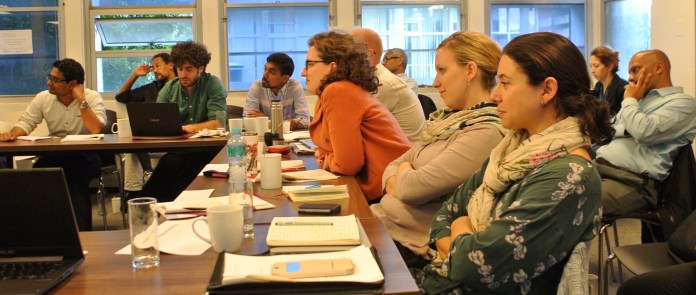
Version 2

Image by Forum Transregionale Studien. From left to right: Abdur Rahoof Ottathingal, Meikal Mumin, Nir Shafir, Naveen Kanalu, Olly Akkerman, Australian Git, Shamil Jeppie, Judith Bihr, Susana Mollins Lliteras, Lena Salaymeh, Arun Rasiah.

Islam Dayeh, co-director of Zukunfstphilologie, declared World Scripts to be “the best Winter Academy ever”. For my part, the event passed all my expectations. It was possibly the most rewarding conference experience I’ve ever had. I learnt a great deal about African and Middle Eastern scripts and traditions, but here are just few of the more general insights I took from the Academy:

1) Nobody is a philologist

thylacine

The world’s last philologist, pictured in Tasmania in 1933

Sadly, the last philologist died in captivity in 1936 without offspring. On the up side, this has allowed the term ‘philology’ to be rescued from its fustian association with bearded Europeans in armchairs and repositioned as a more exciting post-colonial, post-structural, not-exclusively-Western enterprise. My best attempt at defining philology would be something like “The linguistically informed analysis of texts, their associated technologies and their traditions of reading and reproduction”. A bit like linguistic-anthropology-meets-literary-theory-and-manuscript-history.

2) Humility is a defining characteristic of true intellectualism

Research is not rock and roll.  Yes, it’s true that having a PhD or any higher degree has value in the labour market but this does not mean that academic work is more important than other kinds of work, nor that it has intrinsic glamour from the perspective of outsiders. If academia has any ‘prestige’ it is the kind that is counterfeited and dishonestly circulated by academics themselves.

“Philology is just about the least with-it, least sexy and most unmodern of any of the branches of learning associated with humanism” —Edward Said

Perhaps because philology is so uncool to begin with, there was no swagger among the thirty-odd scholars from around the world who participated, and this made a real difference. In such an egalitarian environment nobody was afraid of admitting doubt or exploring ambiguity. As a result, discussions moved quickly towards the most crucial issues without getting mired in pedantry.

3) Diversity is as important as cross-disciplinarity

Almost as many countries were represented as participants, with a good balance of genders, ages and levels of experience. This mattered for the quality of the discussion. English was the native language of only a handful of us. (The remaining participants were forced to yield to our Anglophone imperialism!)

4) Philology has the potential to be a critical ‘Anthropology of the Good’
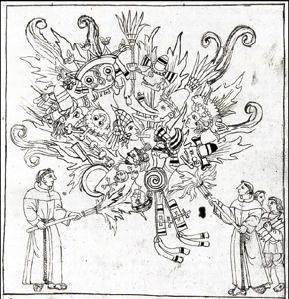
Historia de Tlaxcala

Franciscan monks burning books, 1585

The relationship between people and writing is fraught. On the one hand, writing can be understood as a process of alienation in which meanings are separated from those who produce them and from the context of utterance. But for the same reasons writing and reading can also be experienced as transcendence. Scripts have a capacity to embody or index the beyond, with all the joy and terror that experience entails. Liem Vu Duc—whose own research explores the terrifying (to me) terrain of the Vietnamese bureaucratic manuscript tradition—raised the provocative question of whether writing is necessary for the good life. On the same theme Federico Navarrete Linares described the way that Mexican codices were seen to condense signifier and signified such that the world of gods and monsters was utterly embodied in the text. But he also drew attention to Amazonian traditions of consciously rejecting writing as a practice. All this puts me in mind of Joel Robbins’ paper ‘Beyond the suffering subject: Toward an anthropology of the good’ (2013). Robbins’ powerful idea is to take emic ideas of happiness and fulfillment seriously. The mission of philology—which after all is etymologically a love of letters or the logos—might be about considering the ways in which texts enable or prevent the expression of human happiness.

5) Beware of notions of deficiency – they can always be historicised

Writing is a curiously imperfect technology, and scripts are like tools that can do one very specific job. What happens when the tool is borrowed for a completely different job? Or when the ‘job’ itself changes? In these scenarios it’s tempting to see the tool itself as deficient. This may well be the case, but deficiency is relative to an historical moment. Sometimes, ideologies of modernity will occlude the historical particularities of ‘deficient’ scripts in order to draw an analogy between script reform and a collective moral reform. Various presentations touched on this issue as it has played out historically, but I was particularly interested in Lena Salaymeh’s discussion of the role that ideology plays when it comes to contemporary decisions about how to Romanise words in Arabic script – and that these decisions can affect actual semantics and reception.

6) Modernity is a powerfully paradoxical idea

chinesetypewriter

Caricature of the ‘Chinese typewriter’, shown by Tom Mullaney

Related to the themes of script reform is the slippery idea of modernity itself. To some extent modernity is sustained by a claim to universality and normativity, but in practice it is imagined, future-projected, and historically and geographically relative. In this sense, modernity is a desirable but never-quite-achieved state, having much in common with ideologies of nationhood or even subjectivity. It’s easy to see how scripts can come to represent ideas of modernity—as discussed in Erdem Aydin’s presentations on the Ottoman script—or its opposite, as in Tom Mullaney’s account of the Chinese typewriter (and congratulations, Tom, for incorporating  both MC Hammer and the décor of the seminar room into your analysis).

7) Scripts are imbued with a surplus of meaning

Scripts are contentless and, in most cases, authorless. As Tom Mullaney pointed out, if scripts were inherently meaningful they would not require deciphering. The invention of the telegram, the typewriter and unicode created new problems to address and new opportunities for imposing national, imperial, nativist or utopian ideologies onto writing systems.

8) After the author died, the reader went missing

Conservative literary critics might still be transiting through the denial or bargaining stages following the death of the author. But what of the status of the reader? Michael Allan reminded us that a preconception of the ‘ideal reader’ is always implied in the text, even though such a reader does not exist in practice, and several presentations relativised reading in a striking way.

Bodhisattva Kar’s “Reading Stones, Writing Skins: The Savage Naga and the Limits of Language” considered J.H. Hutton’s colonial ethnography of the Naga of Burma. Hutton was fascinated by Naga practices of tattooing and the manufacture of stone artefacts. In Hutton’s estimation these were texts that he assumed to be intelligible but only on his own terms. As Bodhi put it, Hutton assumed that “the native writes his own culture without being able to read it himself”. Hanna Nieber’s creative multimedia account of the practice of drinking the Qur’an in Zanzibar described the body as a reading subject. Qu’ranic verses are written on a white plate using saffron ink then washed off into vessel. The body of the patient is healed when the liquid is consumed and ‘read’ by it. In fact ritual efficacy may be diminished if the patient were to inadvertently read the text with their eyes, before it is washed off. Margherita Trento’s presentation explored how Catholic missionaries attempted to nativise Christian discourse through the circulation of specially formulated catechisms, doctrinal treatises and prayer books in early modern south India. Choice of script and orthography was crucial to the spiritual authority of the text, particularly in the face of rival Lutheran printing presses. It struck me, in this battle for control of the discourse, how the presumptive reader became sidelined such that texts are characterised as being in dialogue or opposition with other texts without a reading intermediary.

9) … but manuscripts do not burn

timbuktu_ashesThe update from Susana Molins Lliteras on the Tombouctou Manuscripts Project contained a good news story, at least for an ignoramus like me. Remember when rebels sacked Timbuktu in 2013 and burned a whole lot of manuscripts? Not so much. In Susana’s analysis, the famous image of the pile of ashes is likely to have been a result of burning boxes that the manuscripts were contained in. Other missing documents were probably sold by the rebels, not destroyed. In fact, one positive outcome of the attack is that it drew the world’s attention to the fragility of the materials, making preservation work administratively easier.

“Manuscripts do not burn”
—Mikhail Bulgakov

I could only catch the end of Federico Navarrete’s talk, but the great conflagration of Mexican codices on the part of missionaries in the period of early contact was also not as devastating to cultural heritage as might be imagined. Federico noted that hundreds of codices continued to be produced after Spanish conquest in Meso-America and more are still coming to light in informal archives.

10) Long live the radical campus
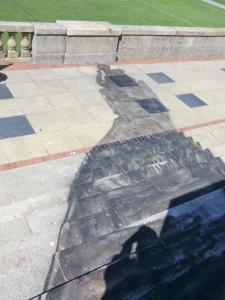
rhodes shadow

The long shadow of Cecil Rhodes

It was exciting to be at the University of Cape Town in the midst of the Rhodes Must Fall campaign. This is a student-led movement with complex objectives but in essence it is a struggle to decolonise the curriculum (and more) and to bring about greater racial equality within the staff and student body. Its defining moment was the decision by the university administration to remove the statue of Cecil Rhodes that commanded a central space in front the campus. Rhodes infamously declared that he would build UCT “out of the kafir’s stomach”, in effect by docking the pay of black mine workers to starvation conditions.

Smaller actions, like the students’ relabelling of university toilets as ‘gender neutral’ were a reminder (to me) of how the arbitrariness of social category systems have a very different resonance in a South African context, where a racial fiction once defined not only your right to use a specific toilet, but your right to an assumption of humanity.

This blog is rarely updated! Want an email notification whenever there is a new post? Click on the button up top that looks like this: Screen Shot 2015-10-18 at 10.02.26 am

Standard
Collection fishing


The figure of one of their diabolical chariots

Yesterday I came upon Thomas Bowrey’s 17th century A geographical account of countries round the Bay of Bengal, 1669 to 1679 (Cambridge: Hakluyt), which you can find on the Internet Archive here. It’s one of those classic gross-out travelogues (“The natives did what?!”) and as a former caption-writer I love this particular image:

The figure of one of their diabolical chariots

Thomas Bowrey. [1905]. A geographical account of countries round the Bay of Bengal, 1669 to 1679. Cambridge: Hakluyt.

Standard
Conferencing

Zukunfstphilologie Winter Academy on World Scripts: Concepts and Practices of Writing from a Comparative Perspective

Next month I’ll be speaking at a Winter Academy on world scripts in Cape Town, thanks to the generosity of Berlin Free University and the Forum Transregionale Studien.

My topics are ‘The preconditions of grammatogeny: A contextual comparison of script invention in Africa and the Asia-Pacific’, and ‘Why do some new scripts fail and others succeed?’.

At least thirteen new script were created in West Africa over the course of the twentieth century, with the most fertile period being the 1920s and 1930s. And there are at least another ten in Southeast Asia and the Pacific but the documentation here is much thinner.

One possible 19th century invention is a script for Bima that I remembered seeing in Plates to Raffles‘s History of Java (1817)I tracked it down yesterday and made a high-resolution scan. Here it is:

An Alphabet formerly adopted in Bima but not now used

An Alphabet formerly adopted in Bima but not now used

As far as I know, this is the only documentation of this script, and there appears to be no relationship with known scripts of the region. The underlying system, on the other hand, looks like a straightforward Indic alphasyllabary with /a/ as the inherent vowel. So my hypothesis is that this is a cipher script for another Indonesian system, and that the scribe was deliberately devising exotic shapes for it. 

An interesting theme in the origin stories for West African scripts is that they were revealed to the inventor in a dream or vision. This narrative turns up in Southeast Asia too, but more commonly script inventors in this region talk of recuperating the system from the distant past through discovery of artefacts, the study of ‘old books’ or studious reflection. I wonder if the “not now used” refers to a claim to antiquity on the part of the inventor?

Standard